
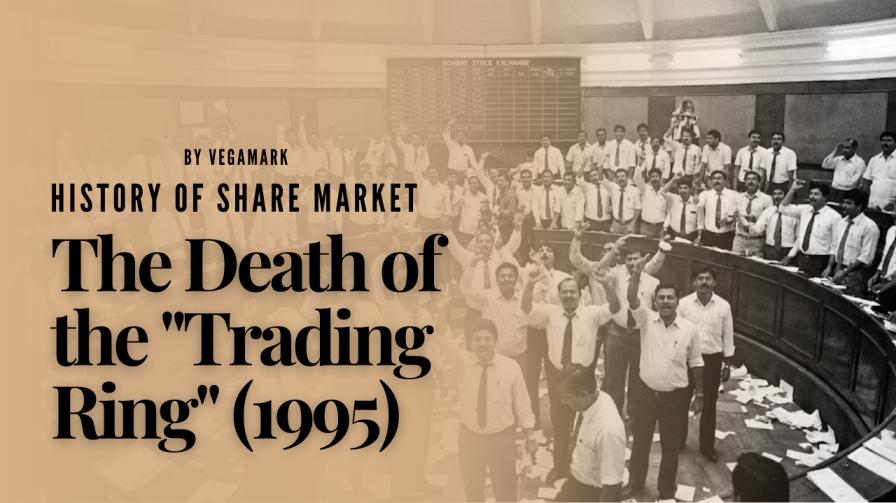
The transition of the Bombay Stock Exchange (BSE) from a physical, shouting trading floor to an electronic limit order book in 1995 stands as the most significant inflection point in the history of Indian capital markets.
Colloquially known as the “Death of the Trading Ring BSE,” this event was not merely a software upgrade. It was the dismantling of a 120-year-old feudal system in favor of a democratized, transparent, and pan-national financial ecosystem. This report explores how the convergence of the 1992 Scam, the rise of the NSE, and global automation silenced the roar of Dalal Street and gave birth to modern trading in India.
1. The Ecology of the Ring (1875–1994)
To understand the magnitude of the change, one must first understand the organism that was the “Trading Ring.” Established in 1875, the BSE operated on the principle of physical proximity.
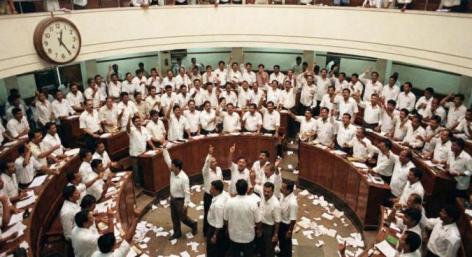
The Physicality of Price Discovery
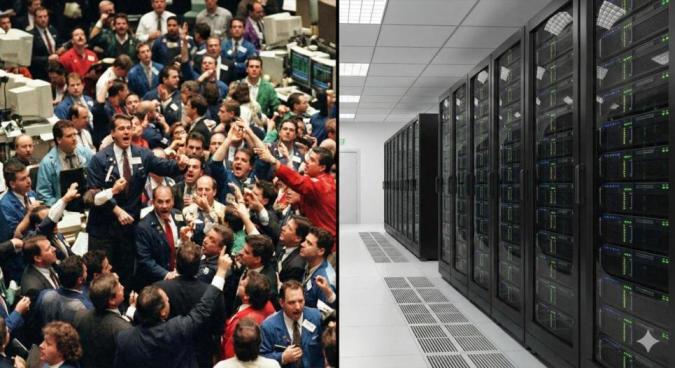
In the pre-digital era, price discovery was a function of acoustics and physical endurance. Traders gathered in the “Rotunda” building in circular pits. The atmosphere was frenetic—a “sea of traders” dressed in white, jostling for space.
- The Roar: During trading hours (12:00 PM to 2:00 PM), the noise level was deafening.
- Sign Language: Because verbal communication was often impossible, traders used a complex lexicon of hand signals. Palms facing out indicated a sell; palms facing in indicated a buy.
- Visceral Trading: Fear and greed were not abstract numbers; they were visible in the sweat and panic on the faces of men in the ring.
The Feudal Lords: Brokers vs. Jobbers
The ring was defined by a strict hierarchy that created a massive conflict of interest:
- The Broker: The agent for the public/client. They held the exchange membership card.
- The Jobber: The “Lord of Liquidity.” Jobbers did not deal with the public. They stood at specific posts and offered “Two-Way Quotes” (a buy price and a sell price).
- The Problem: The system was Quote-Driven. If a jobber refused to quote, liquidity vanished. During crashes, jobbers would widen the gap between buy and sell prices (the “spread”) to protect themselves, effectively freezing the market.
2. The Catalyst for Extinction: The 1992 Scam
While technology provided the means to kill the ring, the motive was provided by Harshad Mehta.
Exposure of the “Club”
The Securities Scam of 1992 brutally exposed the vulnerabilities of the manual system. Harshad Mehta, a product of the ring, understood that the opacity of the “Open Outcry” system allowed for manipulation.
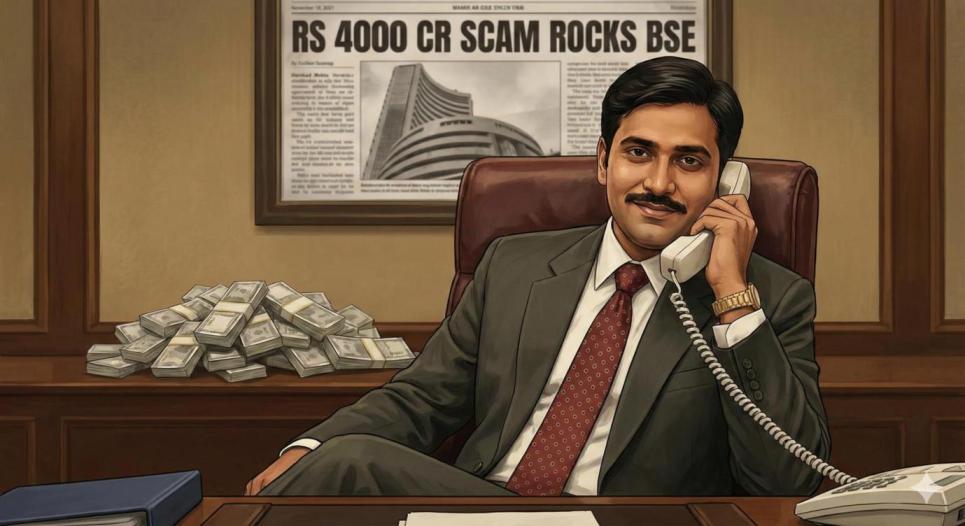
- Circular Trading: Without a digital audit trail, brokers could trade among themselves to artificially ramp up prices.
- The Settlement Crisis: The “Paper Crisis” was endemic. Physical share certificates had to be moved for every trade. The volume of the 1992 boom overwhelmed the back offices, leading to fake certificates and “bad deliveries.”
Regulators (SEBI) realized that the “club” mentality of the brokers and the lack of transparency were systemic risks. The market needed to be demutualized and automated.
3. The Existential Threat: Rise of the NSE
The final push came from competition. Frustrated by the BSE’s resistance to reform, the Government of India sponsored a new competitor: The National Stock Exchange (NSE).
- Born Digital: Unlike the BSE, the NSE launched in 1994 without a trading floor. It used satellite technology (VSAT) to connect terminals across the country.
- The Market Share War: Institutional investors flocked to the NSE’s transparent, electronic system. By October 1995, less than a year after launch, the NSE overtook the BSE in turnover.
The BSE leadership faced a stark reality: Automate or die.
From Roots to Ruins: The Complete History The story of the Indian stock market is a saga of two eras. It began in the 1850s with just five brokers under a Banyan tree, trading on verbal promises and “Cotton Mania” to build the BSE. But a century later, that foundation was shaken by the “Big Bull,” Harshad Mehta, whose ₹5,000 Crore scam in 1992 exposed the system’s flaws and forced the birth of SEBI. Explore the full timeline: read how the market went from the “Cotton King’s” humble beginning to the “Big Bull’s” massive crash.
4. The Transformation: Project BOLT
The transition was christened BOLT (BSE On-Line Trading). It was a cultural revolution executed in just 50 days.
The Death of the Ring (May 1995)
On March 14, 1995, the BSE inaugurated BOLT. For a brief “hybrid” period, the ring and the screen co-existed. However, the efficiency of the screen was undeniable.
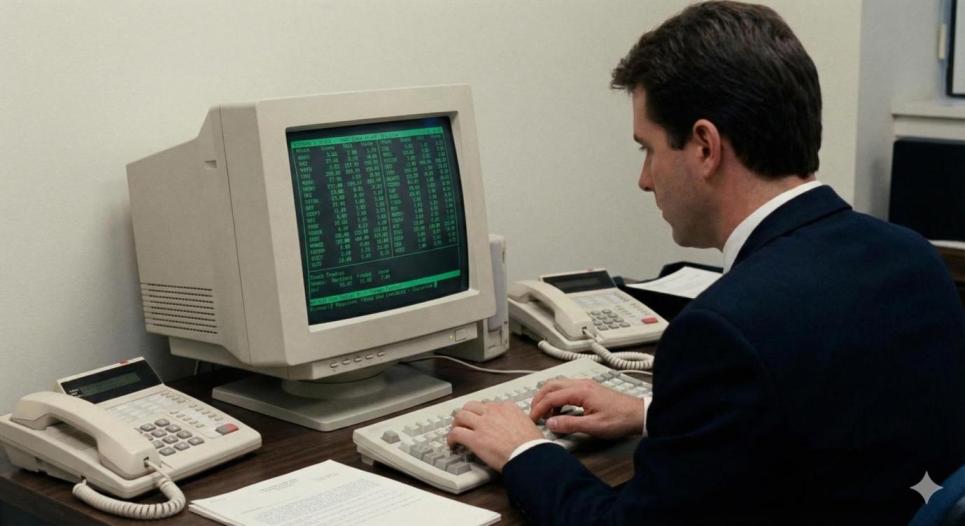
- The Silence: in May 1995, the trading floor held its final session. The cacophony of shouts was silenced forever.
- Global Speed: While the New York Stock Exchange retained a hybrid floor model for decades, the BSE leaped from the 19th century to the 21st in a single year.
The Resistance
The transition was not bloodless. “Jobbers” staged strikes, protesting the transparency of the new system. Their grievance was economic: the screen destroyed their information asymmetry and their ability to profit from wide spreads.
5. The New Order: A Shift in Microstructure
The move from the Ring to BOLT fundamentally altered the DNA of the Indian market.
From Quote-Driven to Order-Driven
The most significant change was the shift to an Order-Driven market. Prices were no longer negotiated by jobbers; they were matched by a server algorithm based on price and time priority.
| Feature | Open Outcry (Pre-1995) | BOLT System (Post-1995) |
| Market Type | Quote-Driven (Jobber dependent) | Order-Driven (Anonymous matching) |
| Execution Speed | Minutes (Physical search) | Milliseconds |
| Transparency | Low (Opaque, verbal) | High (Real-time depth) |
| Reach | South Mumbai (Dalal St) | National (450+ Cities) |
| Trading Hours | 12:00 PM – 2:00 PM | 9:55 AM – 3:30 PM |
Economic Impact
- Death of the Spread: In the manual era, spreads on liquid stocks were often wide (>1.25%). Post-BOLT, spreads collapsed to 0.1% – 0.25%, significantly lowering costs for investors.
- Democratization: Before 1995, you effectively had to be on Dalal Street to trade. BOLT expanded terminals to over 400 cities, integrating India’s regional liquidity into a single national pool.
6. Conclusion
The silence that fell upon the BSE Rotunda in May 1995 was a “creative destruction” of the highest order. It destroyed the livelihood of the traditional market maker and erased the vibrant, chaotic culture of the floor. However, it was the necessary sacrifice required to integrate India into the global financial order.
The Ring was a relic of a feudal age where information was hoarded. The screen is the harbinger of a democratic age where access is ubiquitous. Today’s BSE, operating at speeds of 6 microseconds, stands on the digital foundation laid during that turbulent transition in 1995.