
Introduction to Stock Market Indices
If you’ve ever watched financial news or checked the stock market, you’ve probably heard terms like Sensex and Nifty being thrown around. But what do they actually mean? These are stock market indices—essentially, a way to measure how a specific group of stocks is performing. Think of them as a scoreboard for the stock market, reflecting overall market trends and investor sentiment.
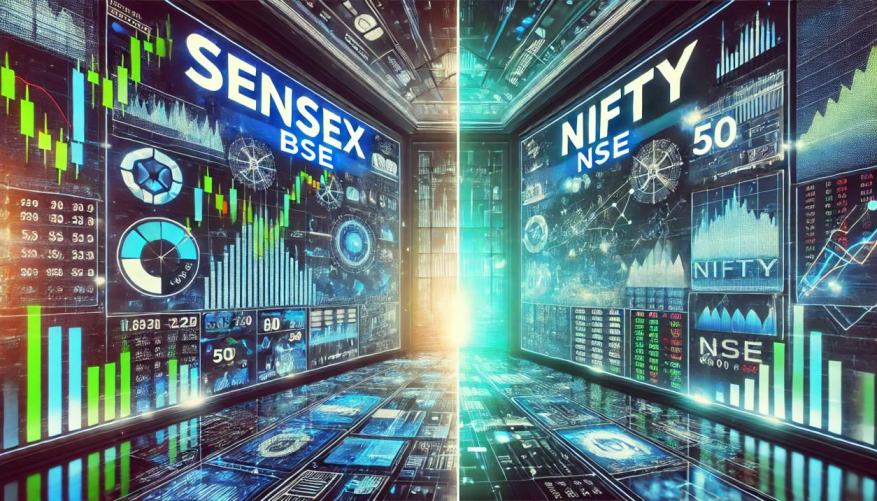
Alt Tag:
Infographic comparing Sensex and Nifty stock indices, highlighting key differences in stock count, exchange, market coverage, and sector representation.
What Are Stock Market Indices & Why Do They Matter?
A stock market index is a basket of selected stocks that represents a particular segment of the market. Instead of tracking individual stocks, indices give you a big-picture view of market movements. If an index goes up, it generally means the stock market is doing well; if it drops, it signals a decline.
So, why should you care about indices like Sensex and Nifty?
- They help investors make informed decisions – If an index is rising steadily, investors see it as a sign of market strength. If it’s volatile, it may indicate uncertainty.
- They act as economic indicators – A booming Sensex or Nifty often reflects strong business growth, while a downturn can signal economic trouble.
- They serve as benchmarks – Mutual funds and ETFs track these indices, helping investors measure their own portfolio performance.
- They attract foreign investments – Global investors keep a close eye on Indian indices to decide whether to invest in the country’s markets.
Simply put, Sensex and Nifty are more than just numbers—they represent the pulse of India’s stock market and play a key role in shaping investment strategies.
What is Sensex?
Sensex, short for the BSE Sensex, is the benchmark stock index of the Bombay Stock Exchange (BSE). It tracks the performance of 30 of the largest and most actively traded companies in India, making it a key indicator of market trends and investor confidence. Launched in 1986, it is one of the oldest and most widely followed stock indices in the country.
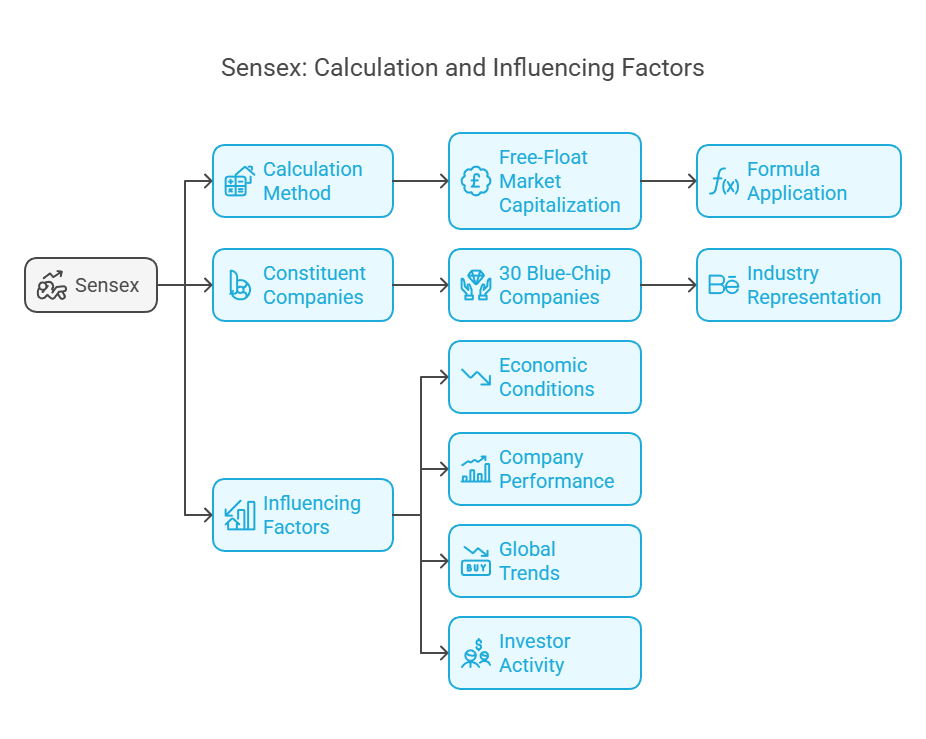
How is Sensex Calculated?
Sensex is based on the free-float market capitalization method. This means that instead of considering a company’s total market value, it only accounts for shares available for public trading. The index value is then calculated using a formula that reflects stock price movements and overall market conditions.
Which Companies are in the Sensex?
The index is made up of 30 blue-chip companies from different industries, including banking, IT, energy, consumer goods, and healthcare. These companies are chosen based on factors like market size, liquidity, and overall representation of the economy.
What Affects Sensex Movements?
Several factors drive the ups and downs of the Sensex:
- Economic Conditions – Inflation, GDP growth, interest rates, and government policies all impact market performance.
- Company Performance – Quarterly earnings, major business decisions, and financial stability affect stock prices.
- Global Trends – International market movements, oil prices, and geopolitical events can influence investor sentiment.
- Investor Activity – Buying and selling patterns, especially by large investors like Foreign Institutional Investors (FIIs) and Domestic Institutional Investors (DIIs), can create market swings.
Tracking the Sensex helps investors understand market trends and make informed investment decisions. It reflects the overall health of the Indian stock market and plays a crucial role in shaping financial strategies.
What is Nifty?
Nifty 50, also known as NSE Nifty, is the benchmark index of the National Stock Exchange (NSE). It reflects the performance of the Indian equity market by tracking the top 50 companies listed on the NSE across different sectors.
Calculation Method:
Nifty is calculated using the free-float market capitalization method, which considers only the shares available for public trading, excluding promoter-held shares. This provides a realistic picture of market movements.
Composition:
The index comprises 50 large-cap companies from various sectors, including banking, IT, energy, FMCG, and more, offering a diversified view of the market.
Factors Influencing Nifty Movements:
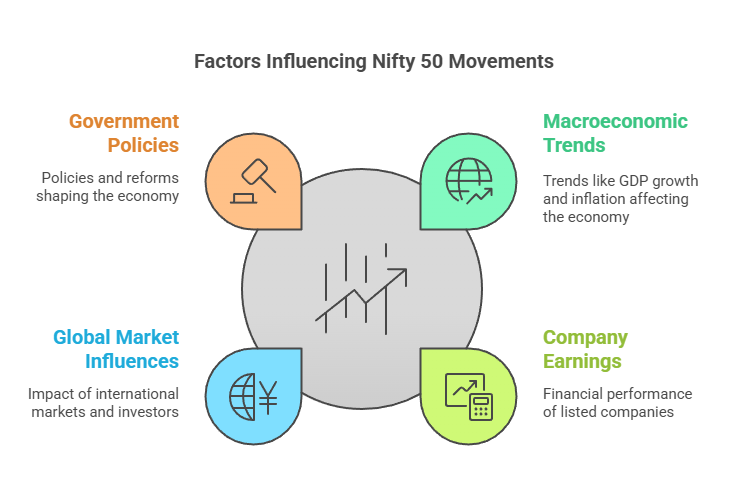
Nifty’s performance is affected by several factors such as:
- Macroeconomic trends like GDP growth, inflation, and interest rates
- Company earnings of the listed firms
- Global market influences and foreign investor activities
- Government policies and economic reforms
Since Nifty includes a wider range of companies compared to Sensex, it provides a broader outlook on the Indian economy and stock market trends.
Key Differences Between Sensex and Nifty
While both Sensex and Nifty track large-cap stocks in India, they have some distinct differences that influence investor preferences and market behavior. Let’s break down the key differences:
| Parameter | Sensex (BSE) | Nifty (NSE) |
| Number of Stocks | 30 | 50 |
| Stock Exchange | Bombay Stock Exchange (BSE) | National Stock Exchange (NSE) |
| Calculation | Free-float market cap method | Free-float market cap method |
| Base Year | 1978 (Base Value: 100) | 1995 (Base Value: 1,000) |
| Sector Coverage | 9 sectors | 14 sectors |
| Market Coverage | ~45% of India’s equity market | ~65% of India’s equity market |
| Rebalancing | Continuous | Semi-annual |
- Stock Exchange:
Sensex tracks companies listed on the Bombay Stock Exchange (BSE), while Nifty follows the stocks of the National Stock Exchange (NSE). This fundamental difference in stock exchange means the indices reflect slightly different segments of the market. - Market Representation:
Nifty has a broader reach, representing about 65% of India’s equity market, while Sensex covers only around 45%. This gives Nifty a more comprehensive snapshot of India’s stock market, with a better representation of mid-cap and smaller companies. - Liquidity & Volatility:
Nifty enjoys higher liquidity, largely due to the NSE’s dominance in derivatives trading. This can make Nifty less volatile, as more liquidity tends to smooth out price movements. - Sectoral Composition:
When it comes to sector coverage, Nifty is more diversified, tracking stocks from 14 different sectors, compared to Sensex’s 9 sectors. This broader sectoral mix means Nifty is generally more diversified, reducing sector-specific risks.
Each of these differences can influence how investors use these indices to guide their investment decisions, and understanding them is key to making informed choices.
Historical Performance: Sensex vs. Nifty
When we look at the long-term performance of Sensex and Nifty, we get a better idea of how these indices have reflected the growth of India’s economy.
- Long-term Returns Comparison:
From 2016 to 2021, Nifty showed slightly better growth, with a CAGR of 12.5%, while Sensex followed at 11.5%. This difference comes down to Nifty’s broader coverage, with 50 stocks across a wider range of sectors, helping it capture a larger part of the market growth. - Resilience of Sensex:
Although Nifty has a higher growth rate, Sensex tends to bounce back better over a five-year rolling period. The 30 companies in Sensex are among India’s largest and most established, offering more stability and making it less prone to sharp market swings. - Major Market Events:
- 2008 Financial Crisis: Both indices took a hit during the global financial crisis, but they both recovered strongly in the following years. This showed how the Indian market could weather global storms.
- COVID-19 Crash: When the pandemic hit, both Sensex and Nifty took a huge plunge, but they bounced back faster than expected, with some of their best rallies soon after the crash.
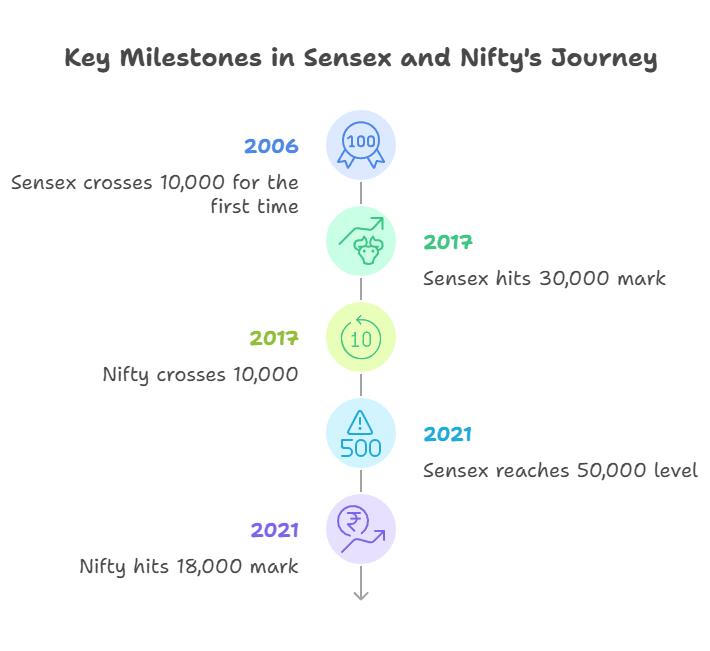
- Key Milestones:
Over the years, both indices have crossed important milestones that highlight their growth:- Sensex crossed 10,000 for the first time in 2006, went on to hit 30,000 in 2017, and more recently reached the 50,000 level in 2021.
- Nifty also crossed 10,000 in 2017 and reached the 18,000 mark in 2021, showing impressive growth as well.
Investment Perspective: Which is Better?
When deciding whether to invest in Sensex or Nifty, it all depends on your personal investment goals and risk appetite.

Alt Tag:
Illustration of two investors comparing Sensex and Nifty stock market indices on a large screen, analyzing investment strategies and market trends.
- Who should invest in Sensex?
- Sensex is great for risk-averse investors who prefer the stability of blue-chip companies. The 30 companies on this list are among the biggest and most established in India, which makes them safer in the long run.
- If you want your investments to be less impacted by market fluctuations, Sensex might be the right choice, as it’s focused on solid, large companies.
- Who should invest in Nifty?
- If you’re after more diversification, Nifty might be the better pick. With 50 stocks spread across multiple sectors, it gives you broader market exposure, which reduces the risk tied to any single sector.
- Nifty is perfect for those looking for a more dynamic portfolio with growth potential. The greater number of companies means you’re more likely to benefit from the success of different industries.
- Mutual Funds & ETFs:
- Both Sensex and Nifty have index funds and ETFs that allow investors to track these indices passively. These funds mimic the performance of the indices, so you don’t need to pick individual stocks.
- ETFs based on these indices are especially popular for those who want to trade in real-time, while index funds are an easier option for investors looking for a longer-term, hands-off approach.
- Institutional Investors’ View:
- FIIs (Foreign Institutional Investors) and DIIs (Domestic Institutional Investors) typically prefer Nifty due to its broader market coverage and higher liquidity, especially for derivatives trading on the NSE.
Ultimately, choosing between Sensex and Nifty depends on your investment goals. Sensex is better for those looking for stability with a focus on top-tier companies, while Nifty offers broader market exposure and more diversification.
Factors Affecting Sensex & Nifty Movements
The movements of Sensex and Nifty are influenced by a variety of factors, both domestic and global. Understanding these factors can give investors better insight into market trends.

- Macroeconomic Factors:
- GDP growth: Strong economic growth typically drives both indices up, as it signals increased corporate earnings and overall prosperity.
- Inflation: Rising inflation can put pressure on companies’ costs, affecting their profitability, which in turn impacts the indices. Conversely, lower inflation tends to support market growth.
- Interest rates: Higher interest rates can lead to reduced consumer spending and borrowing, slowing down business growth. This often negatively affects both Sensex and Nifty. On the other hand, lower interest rates boost borrowing and investment, helping markets rise.
- Rupee valuation: The value of the Indian Rupee against other currencies also plays a role. A weaker rupee can negatively affect companies with significant foreign debt, whereas a stronger rupee helps reduce borrowing costs.
- Government Policies:
- Budget Announcements: Policies laid out in the Union Budget—such as changes in taxes, subsidies, and government spending—can directly impact corporate profits and investor sentiment, causing fluctuations in Sensex and Nifty.
- Tax Policies: Alterations in corporate taxes or individual tax brackets can affect the bottom lines of companies and household consumption, respectively, influencing market performance.
- RBI Decisions: Decisions by the Reserve Bank of India (RBI), especially regarding interest rates and liquidity measures, can have immediate impacts on both indices. A rate cut, for example, could drive markets up by boosting liquidity, while a rate hike might result in declines.
- Global Market Trends:
- US Federal Reserve Decisions: The Federal Reserve’s interest rate policies can significantly impact global capital flows. An increase in US interest rates might cause foreign investors to pull out of emerging markets like India, leading to declines in Sensex and Nifty.
- Crude Oil Prices: Rising oil prices often increase costs for Indian companies, particularly in sectors like transportation and manufacturing. This can lead to a negative impact on market indices.
- Geopolitical Risks: Any geopolitical instability, such as wars, trade conflicts, or sanctions, can create market uncertainty. Investors might pull back from riskier assets, leading to declines in Sensex and Nifty.
- Corporate Earnings & Actions:
- Quarterly Results: Strong earnings reports from major companies tend to lift market indices, while disappointing earnings can cause them to drop.
- Mergers & Acquisitions: Major corporate mergers and acquisitions can cause significant volatility in the markets. Investors react positively to mergers that promise growth, while uncertainty around an acquisition can lead to stock price declines.
Common Misconceptions About Sensex and Nifty
It’s easy for investors to misunderstand how Sensex and Nifty work, especially when markets are volatile. Let’s clear up some common myths:
- “If Sensex is rising, the economy is doing well.”
While it might seem like a rising Sensex means the economy is booming, that’s not always the case. These indices track the performance of a select group of large companies, and while their growth can indicate investor confidence, they don’t always reflect the real state of the broader economy. For example, the Sensex could rise while sectors like agriculture or small businesses might be struggling. - “Both indices always move together.”
While Sensex and Nifty are often correlated, they don’t always move in the same direction. This is due to the differences in their sectoral composition. Sensex has a higher concentration of stocks from industries like banking and energy, while Nifty has a broader spread across 14 sectors. As a result, market events affecting one sector may cause the two indices to behave differently. For example, a rise in tech stocks might drive Nifty up while Sensex remains stable or even dips if other sectors are underperforming.
These distinctions are important because they help investors understand how each index reacts to different economic and market conditions, guiding smarter investment decisions.
Expert Insights & Future Outlook
When it comes to the long-term performance of Sensex and Nifty, experts suggest a nuanced view depending on your investment goals. Analysts agree that both indices have their merits, but the choice between the two depends largely on risk tolerance and diversification preferences.
- Market Analysts’ Perspectives on Sensex vs. Nifty:
Experts often note that Sensex is ideal for conservative investors seeking stability, as it includes the top 30 blue-chip companies with a history of steady growth. It tends to outperform during market rallies due to the strong financial health of its constituents. On the other hand, Nifty offers greater diversification, capturing a broader spectrum of the market with its 50 companies spread across 14 sectors. This makes Nifty slightly less volatile, though it can underperform in times when sectorial growth is uneven.
Analysts point out that Nifty‘s wider scope allows it to better absorb shocks from sector-specific downturns, making it a solid choice for long-term investors looking for a broader exposure to India’s growth. Conversely, Sensex is seen as a safer bet during uncertain times due to its concentrated focus on the market’s strongest firms. - Future Projections for Indian Stock Markets:
Looking ahead 5-10 years, India’s stock market is expected to continue benefiting from rapid economic growth, increasing foreign investment, and a burgeoning middle class. Many analysts predict that the Nifty will outperform Sensex in the long run, due to its higher exposure to sectors like IT, consumer goods, and pharma, which are poised for growth. As India’s economy becomes more diversified and its capital markets mature, investors may increasingly turn to Nifty for better risk-adjusted returns.
Sensex, while maintaining its importance as a barometer of India’s largest companies, might see slower growth compared to Nifty, as it is more concentrated in traditional industries like banking and energy. Both indices are expected to experience volatility due to global economic conditions, but India’s growing digital economy and structural reforms are likely to support steady growth in the broader market.
FAQs on Sensex vs. Nifty
- Can I invest directly in Sensex or Nifty?
No, you can’t directly invest in Sensex or Nifty as they are indices, not individual stocks. However, you can invest indirectly through index funds or ETFs (Exchange Traded Funds) that track the performance of these indices. These funds mimic the composition of Sensex or Nifty, allowing you to invest in the same stocks as the index. - Which index is less risky?
Sensex is generally considered less risky because it includes fewer stocks, all of which are large, established blue-chip companies with stable earnings. These stocks are less volatile and provide steady returns over time. Nifty, with its 50 stocks, is slightly more diversified and thus spreads out risk, but its broader sector coverage may introduce some volatility due to market fluctuations in different sectors. - How are companies added to these indices?
Companies are added to Sensex and Nifty based on factors like market capitalization, liquidity, and sector representation. The index committees at BSE and NSE review companies quarterly and decide which stocks best reflect the market’s performance. Sensex typically includes companies that dominate their industries, while Nifty represents a more comprehensive cross-section of sectors. - What’s the difference between Nifty 50 and Nifty Next 50?
Nifty 50 represents the top 50 large-cap stocks on the NSE, while Nifty Next 50 includes the next set of 50 stocks that are likely to enter the Nifty 50 in the future. These companies are usually in the mid-cap category and have strong growth potential, but they’re not as stable as those in the Nifty 50. Investing in Nifty Next 50 can offer higher returns with a bit more risk.
Conclusion
In conclusion, Sensex and Nifty offer different investment opportunities depending on your risk profile and market outlook. Sensex provides stability through its focus on top-tier companies, while Nifty offers broader market exposure and diversification, which can help mitigate risks.
- Which one should you choose?
If you’re a conservative investor looking for stability and long-term growth from the market’s biggest players, Sensex might be a better choice. However, if you’re looking for a more diversified portfolio with exposure to emerging sectors, Nifty could provide better opportunities for growth.
We encourage you to think carefully about your investment goals and consider speaking with a financial advisor before making a decision.
Feel free to leave any questions or thoughts in the comments below. We’d love to hear your views or help clarify any doubts you may have. Additionally, explore more of our resources to make informed investment choices!